Copenhagen - Two extracts
A swarm of 10,000 geese
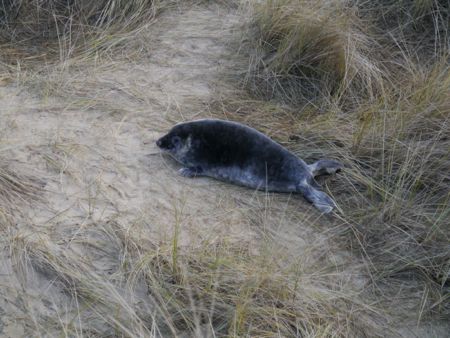
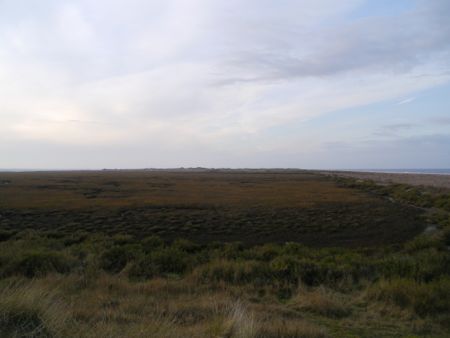
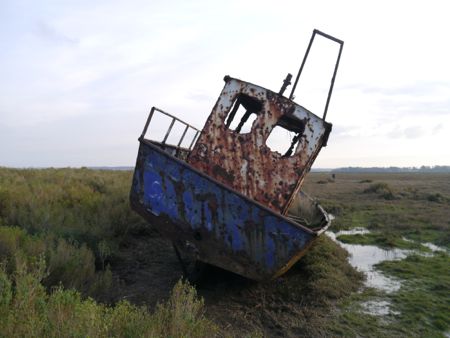
We fairly quickly decided to abandon Horsey as although there were quite a few adults and juveniles at the water’s edge singing quite beautifully the conditions were not good and we could not really get close enough. We learned later that the best way to get close to the seals when they are hauled out in this way is to approach by water otherwise they simply dive into the sea and are gone. We’ll have to go back with a boat some time! We moved onto Blakeney and after a lunch of locally picked Morston mussels set out on a long walk along the spit. It didn’t take long for me to wish I had travelled a little lighter, particularly as I was carrying everything over my shoulder in a Lowepro classified 250AW (including 744, SQN 4s, various mics, 50m of xlr cables and the Collins bird guide). Unfortunately we ran out of daylight before we could reach the seal haul out spot which was a lot further than we had counted on! I did manage to get a nice few minutes of desolate salt marsh atmosphere though:
Unperturbed by the lack of acquiring our ‘targets’ we did a little research in the hotel bar and found another spectacle which looked promising, the dawn flight of thousands of pink-footed geese as the they leave their night time roosts in the RSPB reserve at Snettisham.
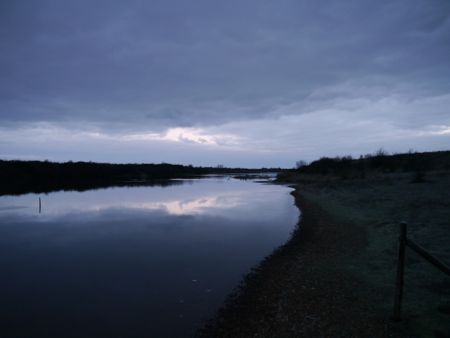
The following are a couple of recordings taken from the dawn chorus period (which was about 6:00AM to 7:30AM). All the sounds were recorded onto my Sound Devices 744 with a pair of Sennheiser 8040s in an ORTF arrangement.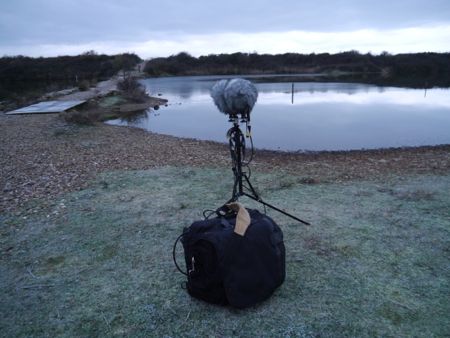
Finally we stopped off on the way home at WWT Welney (http://www.wwt.org.uk/visit/welney/) and I took this nice recording of some Bewick’s swans as they were being fed. This time I was recording to my 744 via an SQN 4s using an old T-powered Sennheiser 416.
The hidden sounds of Tottenham Marshes
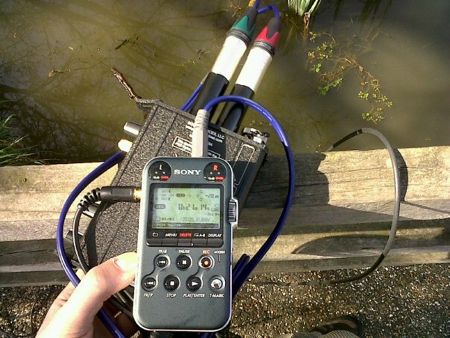
I wasn’t that hopeful as just two weeks ago when I had been here doing a hydrophone workshop I had been met with a barrage of silence. The warm weather we’ve had recently though must have awoken the insects as they were in full choral glory as you can hear:
After a while listening to this and explaining and sharing with the equally confused and intrigued passers by (I love the excited looks on their faces as they put on the headphones and listen to the hidden underwater world for the first time!) I decided to move the microphone around a little to see what other insects I could find, if any. I pretty quickly hit upon this really nice stridulation sound:
I then decided to switch to a totally different type of transducer, the electro-magnetic pick-up the kind you can buy from most electrical component retailers as ‘telephone pick up coils’ (which I usually cut out of their protective plastic housing in order to improve the high-frequency response). They work on the same principle as electric guitar pick-ups and instead of vibrations caused by sound they transduce electro-magnetic waves into an analogous electric current.
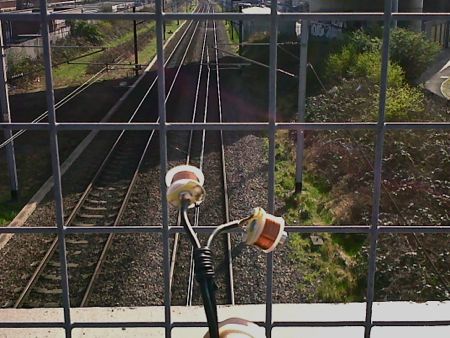
I made some really nice recordings walking around some electricity pylons and sub-stations but buy far the most interesting sounds came from the nearby railway line. Below are a few excerpts from a longer recording of trains passing beneath me.
Sound Maps
Here are a couple more interesting articles/writings on the subject of sound mapping and sonification:
http://spdf.gsfc.nasa.gov/research/sonification/documents/Chapter1.pdf
http://lhcsound.wordpress.com/
http://makingmaps.net/2008/03/25/making-maps-with-sound/
and of course R. Murray Shafer’s book ‘The Soundscape’ (http://www.amazon.co.uk/Soundscape-Sonic-Environment-Tuning-World/dp/0892814551/ref=sr_1_1?ie=UTF8&qid=1332595003&sr=8-1)
Theremin
http://www.bbc.co.uk/news/magazine-17340257